The Mirror Isles are east of the Crossroads in Order of the Sinking Star. You control the Trader and use movable mirrors to transfer yourself and objects between islands. Begin by reading the relationship between the mirror, the subject being reflected, and the destination, then change the arrangement to reach useful land.
This is an area and mechanic guide, not a complete set of numbered puzzle solutions. Later eastern challenges introduce copies and combine mirror interactions with other worlds. A method that crosses one island gap is therefore a starting point for learning, rather than a sequence you can repeat throughout the area.
Find the eastern route
Collect the map at the Crossroads, then take the road east. The four initial worlds can be approached in any order, and the eastern route is one of the approachable places to begin. You can leave a stubborn puzzle through the menu and explore another direction before returning.
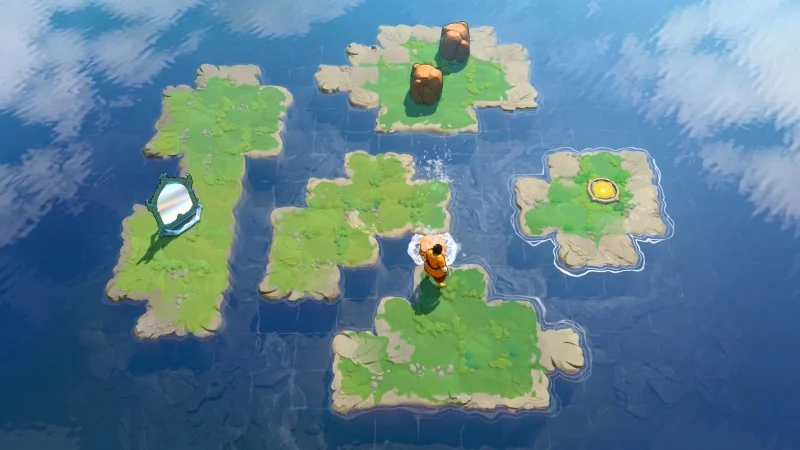
Recognize the Mirror Isles by the island layouts and movable mirrors. The core task is to use reflection geometry to reach positions ordinary walking cannot reach. A path across an island still matters because it determines where the Trader can stand before being reflected.
When identifying an individual puzzle, look beyond its general appearance. Note the number of mirrors, visible objects, characters, and the shape of the islands. Two rooms can use the same reflection idea while requiring different arrangements. Do not apply a move sequence merely because both screenshots contain water and a mirror.
Read the mirror and the reflected position together
A movable mirror changes the relationship between positions. Before pushing it, inspect where a reflection would place the relevant subject. Then compare that destination with useful land, obstacles, and the next action you want to perform.
Moving the Trader and moving the mirror are different adjustments. The first changes the position being reflected; the second changes the geometry used by that reflection. Try one adjustment at a time when you are learning the rule. If both change together, it becomes harder to understand why the destination moved.
A good diagnostic question is whether the current reflection reaches the wrong place or reaches the right place from an inaccessible starting position. In the first case, the mirror arrangement needs attention. In the second, you need a way to put the Trader or object at the relevant position before reflecting it.
This distinction prevents an unhelpful habit: repeatedly pushing the mirror until something happens. The island geometry gives you useful constraints. Locate the target land first, then inspect which available starting positions relate to it through the mirror.
Give movable objects a purpose beyond clearing space
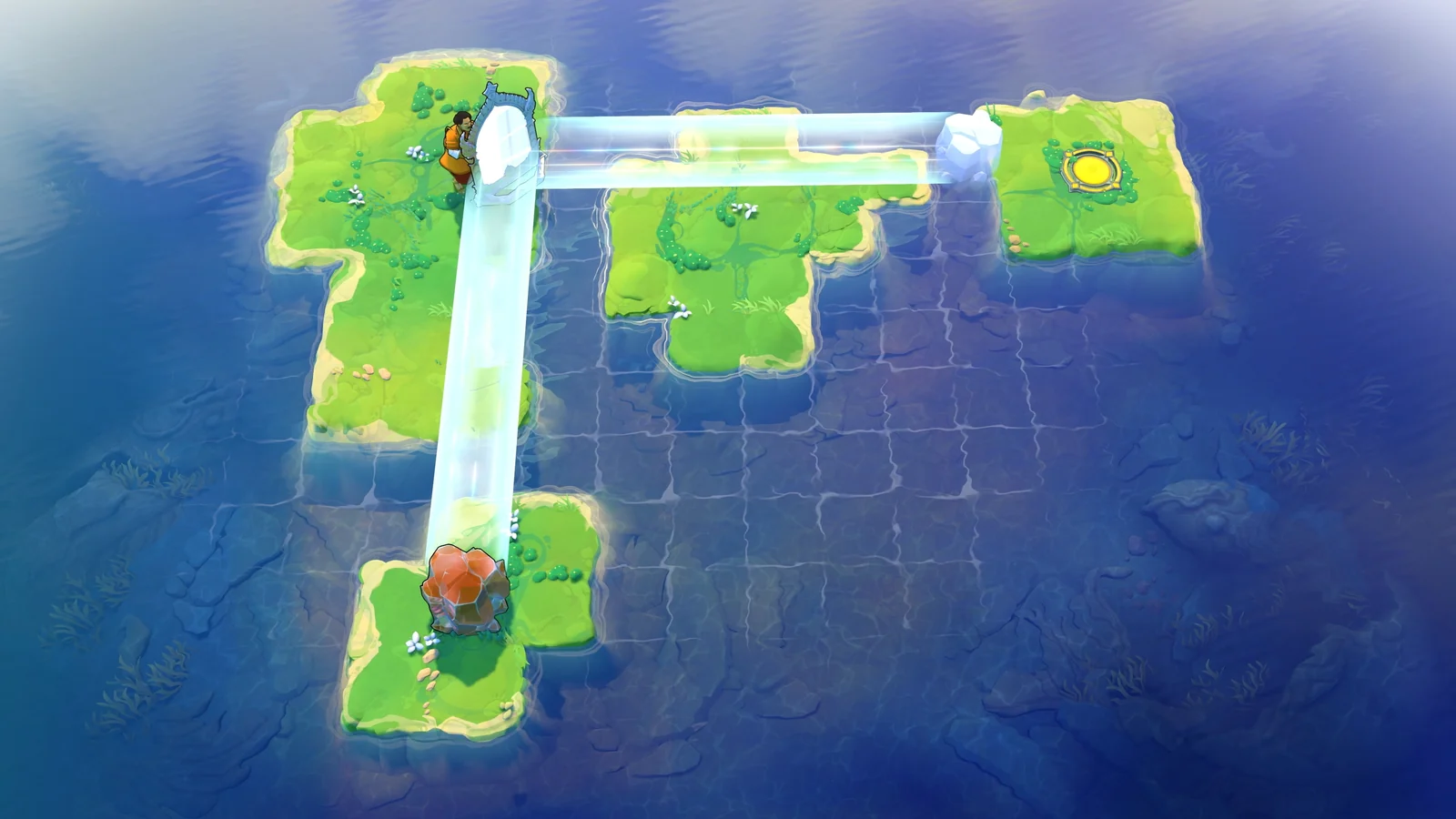
Mirrors can transfer objects as well as the Trader. A rock may be an obstacle on the starting island and a useful part of the arrangement elsewhere. Before moving it aside, inspect what placing it across the gap would allow you to do.
Think about the next condition after the reflection. Can the Trader approach the object from a useful side? Does the new object position preserve access to the mirror? Have you moved the object somewhere that can help the route, rather than somewhere that simply makes the original island look clearer?
These questions are especially useful when a successful crossing seems to leave you stuck. Reaching another island is an intermediate result. The puzzle is about establishing a usable arrangement, which may require the object to cross before the character or a return to an earlier island.
If an object is now in an unhelpful position, undo to inspect the last decision. Compare the position it occupied before the move with the role you wanted it to serve. The useful correction might concern the reflection setup, the character's approach, or the order of two object movements.
Treat narrow island tiles as candidate positions
The shape of an island affects which reflection starts are available. A protruding tile, a dock, or a narrow strip may provide a position that changes the destination meaningfully. Inspect those spaces before assuming the nearest shore is the only usable launch point.
This is an observation method, not a claim that every tile has a mandatory role in every solution. The point is to include reachable geometry in your reasoning. A square can matter even when it does not lead anywhere by ordinary walking.
Work backward from a destination you can identify. Decide where the Trader must land to continue, then consider how a mirror could connect a reachable starting position to that square. If the direct island-to-island transfer does not fit, inspect whether an intermediate position changes the geometry.
Avoid adding unsupported tile counts to this process. Without a specific room and starting state, “move the mirror three squares” is not a reliable instruction. Count movements only after you have identified the relevant arrangement on your own board.
Prepare for character copies
Later mirror puzzles introduce duplication. When multiple copies appear, inspect their positions together rather than following one of them exclusively. A movement that helps the character nearest the exit can change another part of the board in an unhelpful way.
The presence of copies changes the planning problem. You need to understand which characters the current puzzle lets you control, where each can move, and what final arrangement the room requires. It is no longer enough to find one successful reflection for one character.
Do not assume every duplicate room uses the same control relationship. Identify the interaction in the room you are playing before applying a technique from another puzzle. The detailed rules for clone movement and mirror swapping need their own room-specific inspection; this area guide introduces the change in scope without supplying an invented universal sequence.
Recognize when another world's rules have joined the puzzle
The Mirror Isles form one foundation of a broader interconnected game. Later areas combine mirrors with other systems, including heroes and stones. Seeing a familiar mirror therefore does not guarantee that the rest of the puzzle behaves like an early eastern island.
First identify the controlled characters. A hero who pushes, a Wizard who swaps, or a Sailor who skips stones can use the reflection system for a different purpose. Then identify the objects that move through water, react to light, or influence another character's access.
For a mixed puzzle, keep the actions distinct while planning. The mirror determines a transfer, but another mechanic may determine what that transfer accomplishes. A stone can reach a useful position through reflection and then need a separate launch. A hero can reach a new island and still require help establishing the final path.
Later example: establish the bridges in Mirrors and Stones
One concrete example of the change in scope appears in Mirrors and Stones Part 4, Stage 3. This is a later mixed-area puzzle, not an early Mirror Isles room. It uses the skipping stones as objects to reflect into useful water positions while the characters gain access to the next part of the arrangement.
The sequence begins by moving the mirror up and left, then reflecting a skipping stone into the small gap. Move the mirror right and reflect the controlled character so you can reposition the mirror south, in line with the third stone. Reflect that stone to establish another bridge. Finally, move the mirror to the end of the dock and reflect the stone that completes the Trader's path.
The practical lesson is that a familiar mirror has a different job when a second world's objects are present. In an ordinary eastern room, your immediate goal may be a character transfer between islands. In this mixed example, the early transfers establish the water route that makes the character's later movement useful.
Identify which arrangement you are playing before applying that lesson. Look for the dock, the small gap, and the skipping stones associated with the sequence. If those elements are absent, use the general geometry checks earlier in this guide rather than trying to recreate a bridge with unrelated objects.
After each reflection, inspect the new object position and the route it creates. The intermediate result should supply access for the next mirror adjustment. If you can reflect an object but cannot reach the side needed to reposition the mirror, return to the preceding arrangement and check the character transfer. Completing an object movement and preserving access are separate conditions, and the later mixed rooms require both.
Make the next experiment answer one question
When an eastern puzzle stalls, identify the smallest unresolved condition: the wrong landing position, an object on the wrong island, inaccessible turning space around a mirror, or a copy that cannot finish the needed route. Then choose an experiment that tests that condition alone.
Use undo to compare the result with the earlier arrangement. Keep the useful observation even if the move does not solve the whole room. Learning that a particular mirror position reaches useful land gives you a constraint for the next action; learning that a crossing removes access tells you what to preserve.
If repeated experiments are no longer teaching you anything, leave the room and explore another route. On returning, inspect the board before continuing. Start from the missing relationship you identified, and use what you have learned to choose a different arrangement rather than repeating the same reflection sequence.