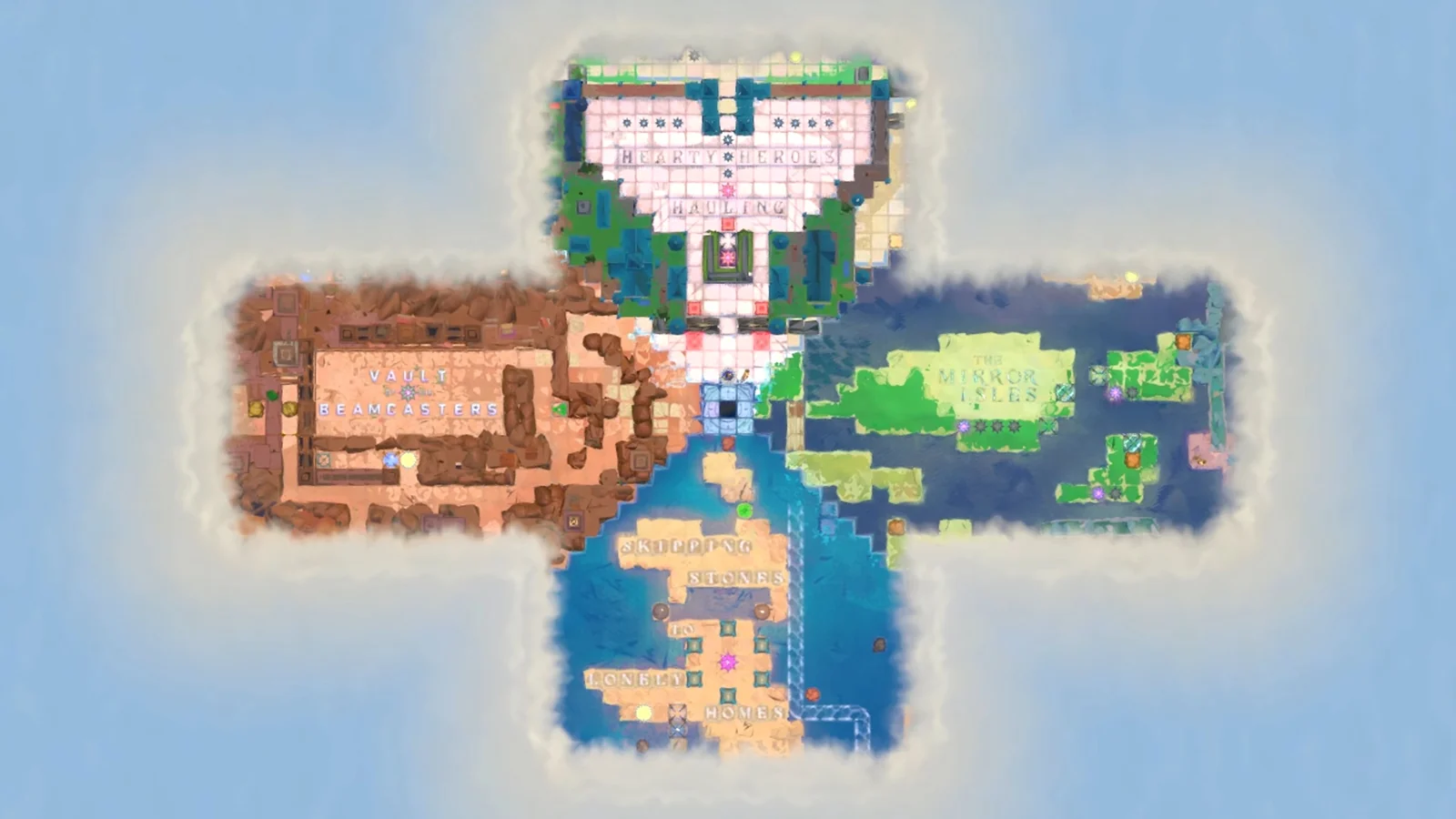
Order of the Sinking Star combines its four regional puzzle systems through Gold Rooms and the areas they connect. The northern heroes manipulate objects with distinct abilities, the eastern Trader uses reflections, the southern Sailor works with skipping stones and waterways, and the western Explorer gains powers from colored beams. A combined puzzle asks you to use those familiar rules together on one board.
Completing a Gold Room bridges two regions and brings their characters and mechanics into contact. There are six pairwise combined areas. You do not need to finish the worlds in one fixed order or reach a universal number of solved puzzles before exploring them. Treat access as a local navigation and puzzle problem, rather than waiting for an assumed global unlock threshold.
Recognize the four systems before planning a combination
The Crossroads connects routes in four cardinal directions. That arrangement helps you identify the origin of a mechanic, even when a later board contains characters from more than one region.
| Direction | Regional system | Main interaction to recognize |
|---|---|---|
| North | The Hearty Heroes of Hauling | Different heroes push, pull, exchange, and otherwise manipulate objects |
| East | The Mirror Isles | Mirrors move characters and objects to reflected positions |
| South | Skipping Stones to Lonely Homes | Stones, water, currents, and rideable lily pads create routes |
| West | Vault of the Beamcasters | Gems power colored beams that grant traversal and interaction abilities |
This is a reading aid for a mixed board, not a recommended completion order. The regional opening puzzles teach the parts separately. When those parts later meet, identify which familiar effect is responsible for each visible result. A reflection changes position; a hero interaction changes the object arrangement; a stone's movement can alter water travel; a beam changes what its recipient can do.
Avoid treating the original games that inspired these systems as walkthroughs for the new rooms. Their ideas provide a foundation, but Order of the Sinking Star contains new puzzles and combinations. Knowing an older game's ending does not establish the route through a Gold Room here.
Understand what a Gold Room changes
A Gold Room is a bridge between systems, not simply a harder puzzle with a different floor color. Its important result is the connection: characters and devices previously encountered separately can now be used in relation to one another.
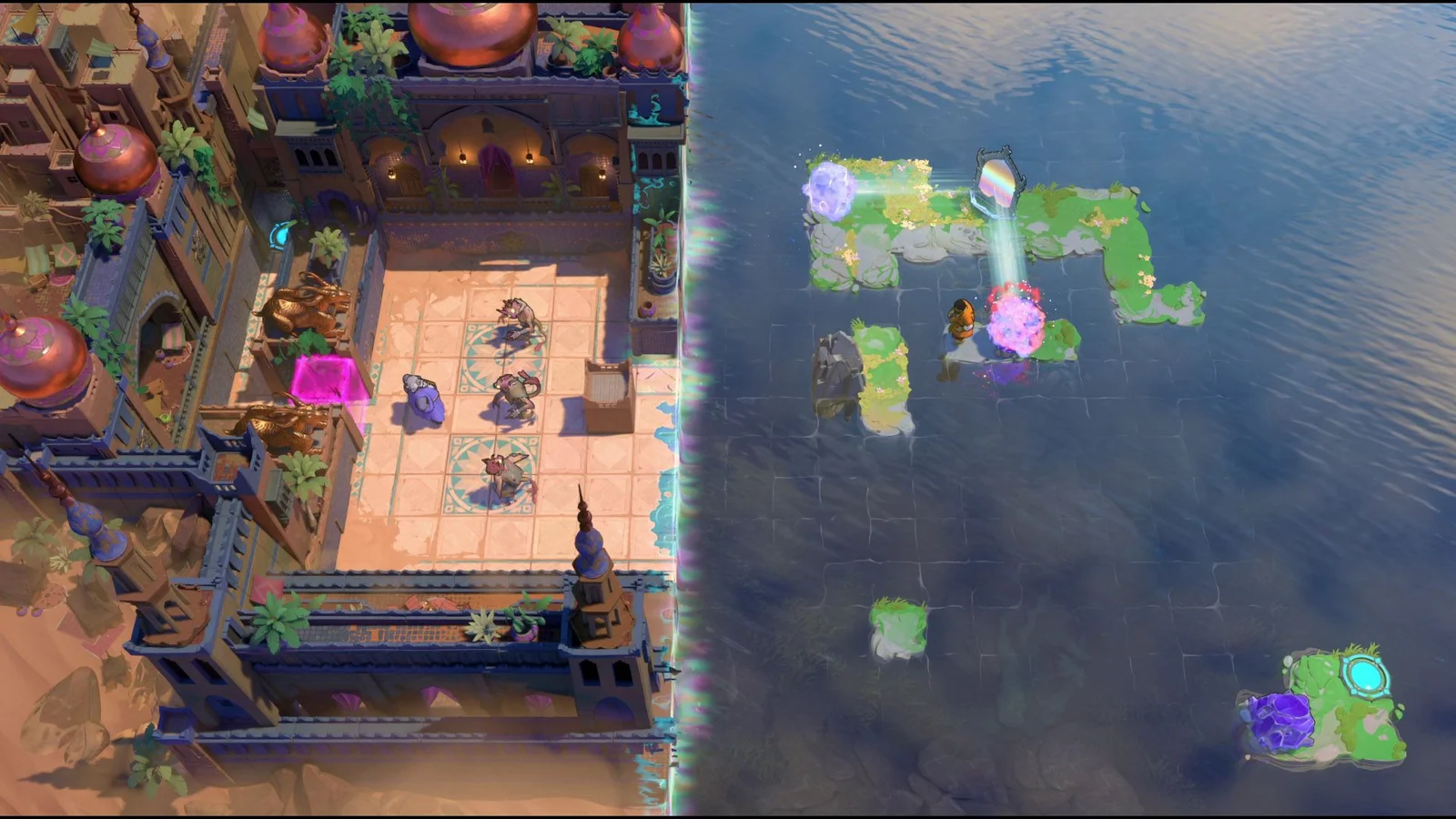
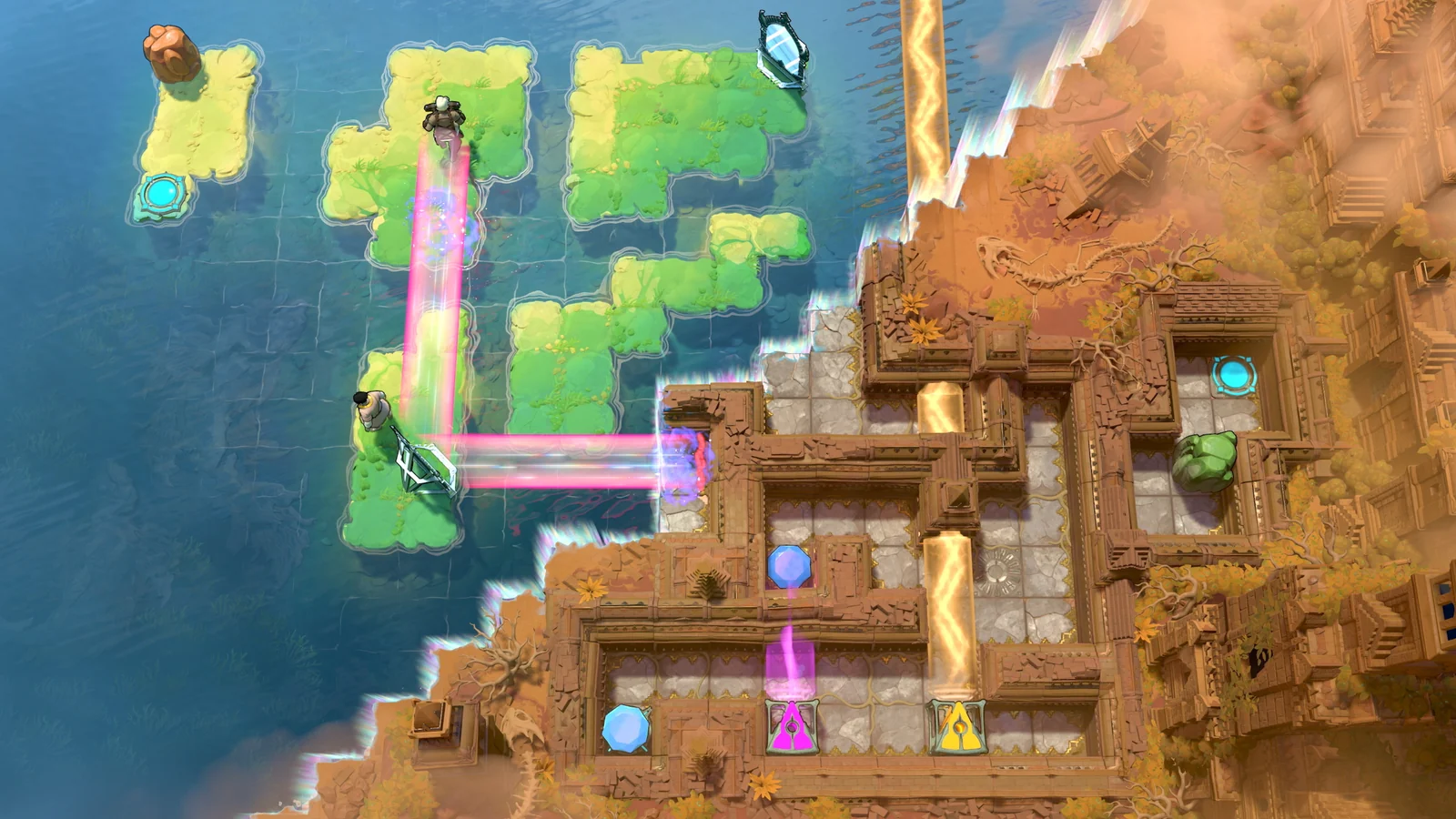
Two established examples are colored beams combined with mirrors, and the northern moving crew combined with the Sailor's stone mechanics. These combinations make a familiar action serve a new purpose. A movement useful for opening a corridor in one region can become part of preparing a water crossing in another. A reflected position can matter because a character needs access to a beam-powered interaction, rather than merely because it reaches another island.
When you enter such an area, inspect the full board before choosing the first active character's move. Find the characters, the relevant objects, and the target positions. Then determine which system controls each obstacle. This prevents a common mistake: repeating the same successful regional technique when the new room requires a second mechanic to prepare the conditions for it.
You can have the correct local idea and still be unable to execute it. For example, reflecting an object may be the right operation while the current mirror position produces the wrong landing point. Or the correct stone route may exist while the character needed to launch it cannot reach the pushing side. The combined puzzle includes those prerequisites.
Plan the handoff between two mechanics
Read a combination as a sequence of states rather than a collection of independent powers. A useful approach is to name the next result you need, then work backward to the action that can produce it.
- Identify the immediate obstruction, such as an unreachable island or an object blocking the route.
- Choose the mechanic capable of changing that obstruction.
- Inspect the position required to use that mechanic.
- Decide which other character or device can prepare that position.
- Make the preparation and verify the resulting arrangement before continuing.
- Preserve any access the first character will need when control returns to them.
These steps describe reasoning, not an automatic solver. They work because the systems affect shared positions. A hero can change the location of an object that a mirror then moves elsewhere. A water mechanism can create a standing position that enables a reflection. The preparation and the final action must therefore fit together spatially.
Be precise about the handoff. Saying that one hero must help another is too broad to test. Saying that the first hero must leave a block where the second can reach its necessary side gives you a visible condition to inspect. If the condition fails, undo to the action that removed it and revise that part of the sequence.
Separate position changes from ability changes
Mirror and hero puzzles often make you focus on where objects are. Beam puzzles add a second question: what can the character do from that position? A location can be geographically reachable while the action needed there remains unavailable.
The western system grants different abilities through colored beams. These include passing through walls, breaking boulders, and long-distance movement. Overlapping beams can provide several powers at once. In a combined board, inspect both the character's location and the beam conditions that matter to the next action.
Do not infer a new interaction simply because a familiar object has entered a new world. Instead, test the supported mechanism in the current arrangement. If a character needs a beam-enabled ability, confirm that the relevant beam reaches the character at the moment of the action. If the puzzle requires an object to be reflected, confirm that the resulting position is useful after the beam-related step.
This distinction also helps you interpret a failed attempt. Reaching the destination but lacking the interaction points toward an ability condition. Having the right ability but no way to stand beside the target points toward positioning. Reworking the wrong part of the board can otherwise consume many moves without addressing the actual obstacle.
Preserve the heroes' automatic interactions
The northern characters' traits remain a central planning constraint when other mechanics join the board. The Warrior pushes, the Thief pulls when moving away from an object, and the Wizard exchanges positions with objects in the direction of movement. Their abilities are built into those interactions.
That means repositioning a hero is not always neutral. A step away can drag an object out of the place you prepared for a reflection. An approach can trigger an exchange and leave the object on a tile another character needed. Consider the entire resulting arrangement rather than just the character's new location.
For a mixed party, plan which hero must act next before finishing the current hero's movement. Keeping an inactive character near an important object can be useful, but occupying a narrow access tile can also prevent the next interaction. Watch for that difference. The room can require repeated switching because each hero provides only part of the sequence.
When a new character joins a system, return to simple tests. Identify one interaction whose outcome you can inspect clearly. Use undo after the test if it disrupts your setup. Once you understand the result, incorporate it into the larger plan. You do not need to guess every possible combination at once.
Account for motion as well as final positions
The water system introduces stones in motion, lily pads, and changing routes through currents. In combined water puzzles, the timing of an interaction can matter alongside its destination. A plan that names only where everything must finish may omit the event that gets it there.
Use the game's time controls when precise timing is part of the room. Slowing time provides room to perform and inspect the necessary interactions. Speeding time can reduce waiting for a moving object to return, such as a lily pad following a circular stream. These tools change pace; undo returns to an earlier state.
Keep the two problems separate. First establish the intended relationship: which object must move, which device will change it, and which route should become usable. Then work on the timing that produces that relationship. Repeatedly attempting a poorly understood timing window is unlikely to clarify a geometric mistake.
If your attempt changes the wrong part of a water route, inspect the motion before the failure rather than immediately rearranging the whole board. Undo can return you to a useful preceding state. The important clue may be the moment an object passed a device, not its eventual resting position.
Treat access in the overworld as another puzzle
The overworld connects the regions, but it also contains navigation puzzles. An area that is visible and difficult to reach is not automatically locked until the end of the game. Examine the nearby passages and devices before assuming a missing global upgrade is responsible.
Gold Room access can involve preparing connections between regional routes. The safe question is what your current route makes reachable, rather than how many hours you have played. Time estimates are especially unhelpful here because the game allows different exploration orders and individual puzzles can take very different amounts of thought.
If a route has stopped producing new ideas, move to another region and learn a different system. The four paths are available without a fixed sequence. Returning later can make a combined interaction clearer because you recognize both of its components. This is a way to improve understanding, not a promise that visiting another region automatically opens the blocked room.
Check a failed combination in two passes
First check the local action. Did the push, exchange, reflection, or beam-enabled interaction produce the result you expected? If it did not, revise your understanding of that immediate operation and repeat a small test.
Then check the connection. Did the result leave the next character able to act? Was the object in the necessary location? Did the movement preserve the route or beam condition needed afterward? If the local action worked but the sequence stopped, the missing step is often this handoff.
Record that distinction mentally before undoing. It gives your next attempt a concrete purpose. You might preserve a standing tile, align a mirror differently, or move a supporting hero first. Once both passes succeed, continue to the next dependency. Combined puzzles become easier to reason about when each verified interaction leaves a board that supports the following one.